AI Answer Generators: How They Work, When to Trust Them, and How to Get Better Answers
By the Stellah Team · Updated July 24, 2026
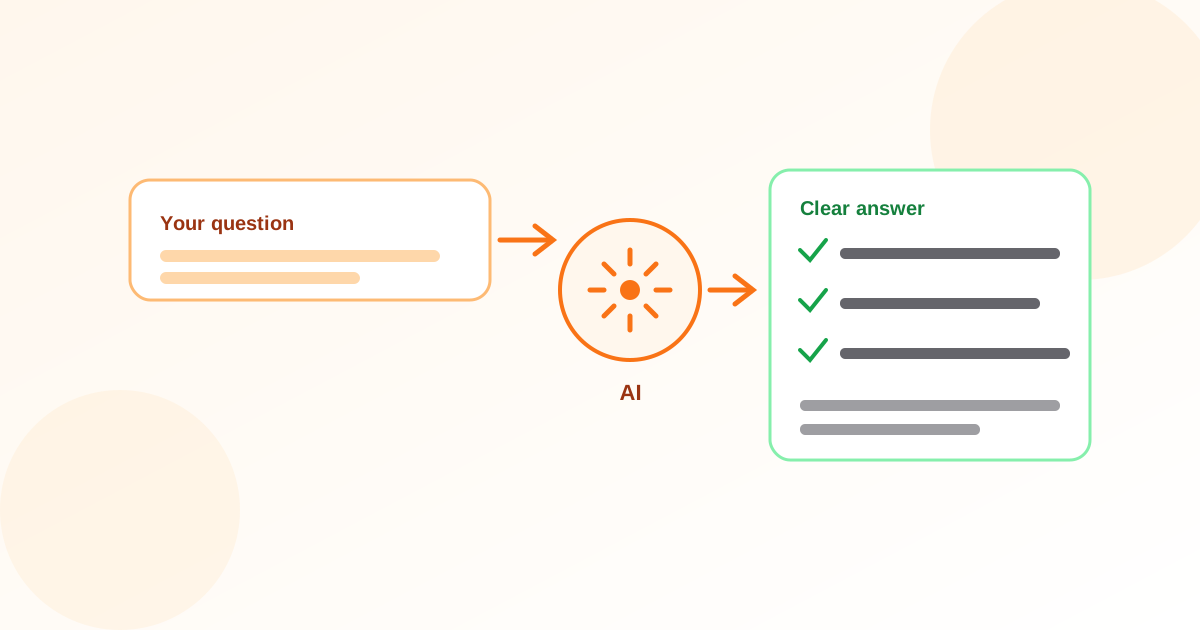
An AI answer generator takes a plain-language question and returns a written answer in seconds — no wading through ten blue links. It's genuinely useful for explanations, drafts, and summaries. It's also confidently wrong sometimes. Knowing which is which is the whole skill.
Here's how these tools work under the hood, where to trust them, and how to phrase questions so the answers are worth keeping.
What's actually happening
A large language model predicts the most likely helpful continuation of your question, drawing on patterns learned from vast text. It isn't looking things up in a database of facts — it's generating language that fits. That's why it's brilliant at structure and phrasing, and why it can state a wrong 'fact' as smoothly as a right one.
Where AI answers are reliable
- Explaining concepts you can then sanity-check ('explain OAuth like I'm five')
- Drafting — emails, outlines, first passes you'll edit anyway
- Transforming text you provide — summarise, rewrite, translate, extract
- Brainstorming options when there's no single correct answer
Where to be careful
- Specific facts, figures, dates, and citations — verify before you rely on them
- Anything after the model's training cutoff, unless it can browse
- Legal, medical, or financial specifics — treat as a starting point, not advice
- Questions about your own business — a general model knows nothing about your data
How to get dramatically better answers
- 1Give context: who it's for, what you already know, what format you want back.
- 2Ask for structure: 'answer in five bullet points', 'show your steps', 'give me a table'.
- 3Constrain it: 'only use the text I pasted', 'say if you're unsure' cuts down invented facts.
- 4Iterate: your first answer is a draft — refine with 'shorter', 'more technical', 'add an example'.
The quality of an AI answer is mostly the quality of the question. A vague prompt gets a vague, hedge-everything reply; a specific one gets something you can use.
When you need answers grounded in YOUR content
General answer generators are great for general questions. But if you want accurate answers about your product, policies, or docs — for customers or your team — you need a model that reads your content, not the whole internet. That's retrieval-augmented generation: the AI answers only from sources you give it, so it can't wander off. It's exactly how an AI support chatbot trained on your site stays accurate.
Try a free AI answer generator — no sign-up, instant.
Free AI Answer GeneratorFrequently asked questions
Is there a free AI answer generator with no sign-up?
Yes — Stellah's AI Answer Generator is free, needs no account, and returns an answer instantly. Nothing you type is stored.
Are AI-generated answers accurate?
Often, but not always. They're reliable for explanations, drafts, and transforming text you provide, and less reliable for specific facts, recent events, and anything about your private data. Verify facts before you depend on them.
How do I get better answers from an AI?
Add context, ask for a specific format, tell it to say when it's unsure, and iterate. Specific questions get usable answers; vague ones get hedged ones.
Can AI answer questions about my own business?
Only if you give it your content. A general model knows nothing about your product or policies — for that you need retrieval over your own docs, which is how an AI support chatbot answers customer questions accurately.