AI Customer Service in 2026: a Practical Guide for Small Teams
By the Stellah Team · Updated July 26, 2026
For a small team, customer questions never stop — but the budget to hire around the clock does. AI customer service closes that gap: it answers the repetitive majority instantly, at any hour, and pulls in a human for the rest. Done well, customers get faster answers and your team stops drowning in the same five questions.
This guide covers what AI customer service actually is in 2026, where it shines, where it shouldn't be trusted, and how to launch it without a developer.
What 'AI customer service' means now
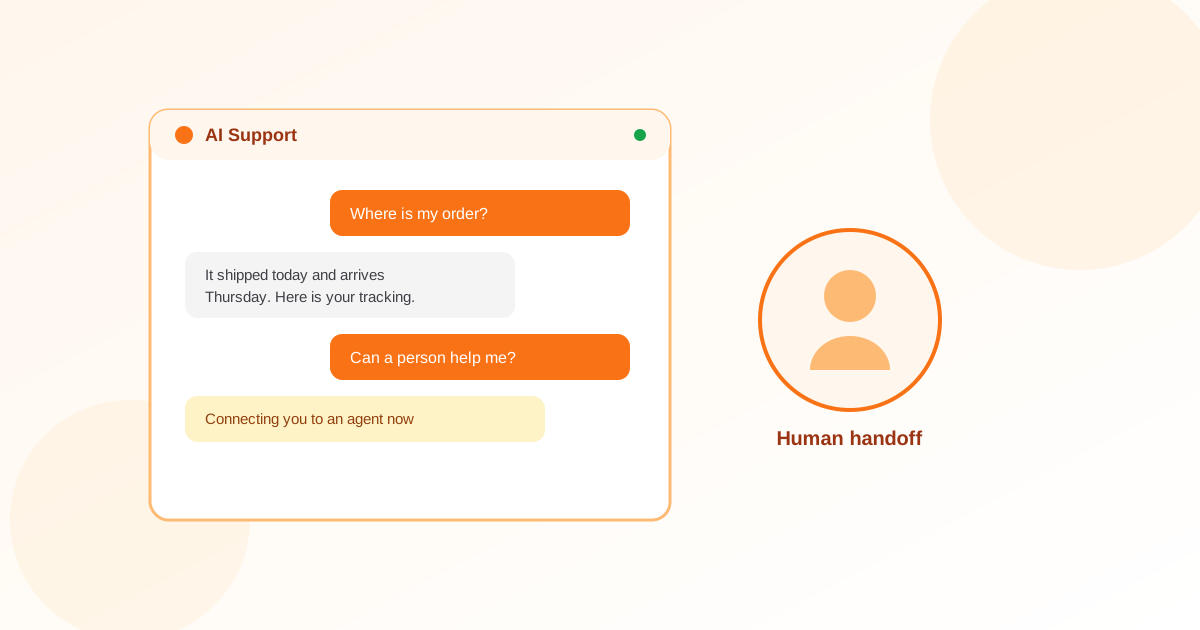
It's no longer a rigid decision-tree bot that frustrates everyone. Modern AI support reads your actual content — help pages, PDFs, FAQs — and answers questions in natural language, grounded in your business. When it isn't confident, or the customer asks for a person, it hands off to a human agent with the full conversation attached.
What it's genuinely good at
- Answering the repetitive 60–80%: hours, pricing, returns, 'where's my order', how-tos
- Instant, 24/7 responses — no queue, no timezone gaps
- Deflecting tickets before they reach your inbox
- Capturing the visitor's question, email, and context even when a human takes over
- Staying consistent — it never has an off day or forgets a policy
What still needs a human
AI should escalate, not improvise, on anything high-stakes: angry or emotional customers, refunds and exceptions outside policy, account-security issues, and edge cases it hasn't been trained on. The goal isn't to remove humans — it's to reserve their time for the conversations that actually need judgment.
How to deploy it in an afternoon
- 1Gather your content: your top FAQs, help pages, and any policy PDFs.
- 2Train the AI on them — upload documents, point it at your site to crawl, or paste FAQs.
- 3Set your handoff rules: when to offer a human, and where those chats land.
- 4Add one line of embed code to your site and test it with real questions.
- 5Review the first week of transcripts and fill any gaps the AI stumbled on.
See how well an AI answers a question before you commit.
Free AI Answer GeneratorThe metrics that tell you it's working
- Deflection rate: share of conversations resolved without a human
- First-response time: should drop to near-instant
- Tickets per customer (or per order): the number that proves you're saving time
- CSAT on AI-handled chats: quality, not just speed
Start small, expand as trust grows
You don't have to automate everything on day one. Start with your most repetitive questions, keep a human close, and widen the AI's scope as the transcripts show it earning trust. A grounded AI agent trained on your own content is the safest way to begin — it answers from your material, not the open internet.
Build an AI support agent trained on your content — free.
Get started with StellahFrequently asked questions
Is AI customer service reliable enough to use?
For the repetitive majority of questions, yes — especially when it's grounded in your own content and hands off to a human for anything it's unsure about. The reliability comes from that combination: automate the routine, escalate the rest.
Will AI replace my support team?
No. It removes the repetitive volume so your team can focus on the conversations that need empathy and judgment. Most small teams use it to scale coverage without hiring, not to cut staff.
How long does it take to set up AI customer service?
With a no-code platform, an afternoon: gather your FAQs and help content, train the AI on them, set handoff rules, and paste one line of embed code. Refining it is ongoing but light.
How is this different from a normal chatbot?
Old chatbots follow fixed decision trees and break the moment a question is phrased differently. Modern AI support reads your real content and answers in natural language, then escalates to a human when needed.