
How to Cut Customer Support Costs Without Cutting Quality: a Practical Playbook
By the Stellah Team · Updated July 18, 2026
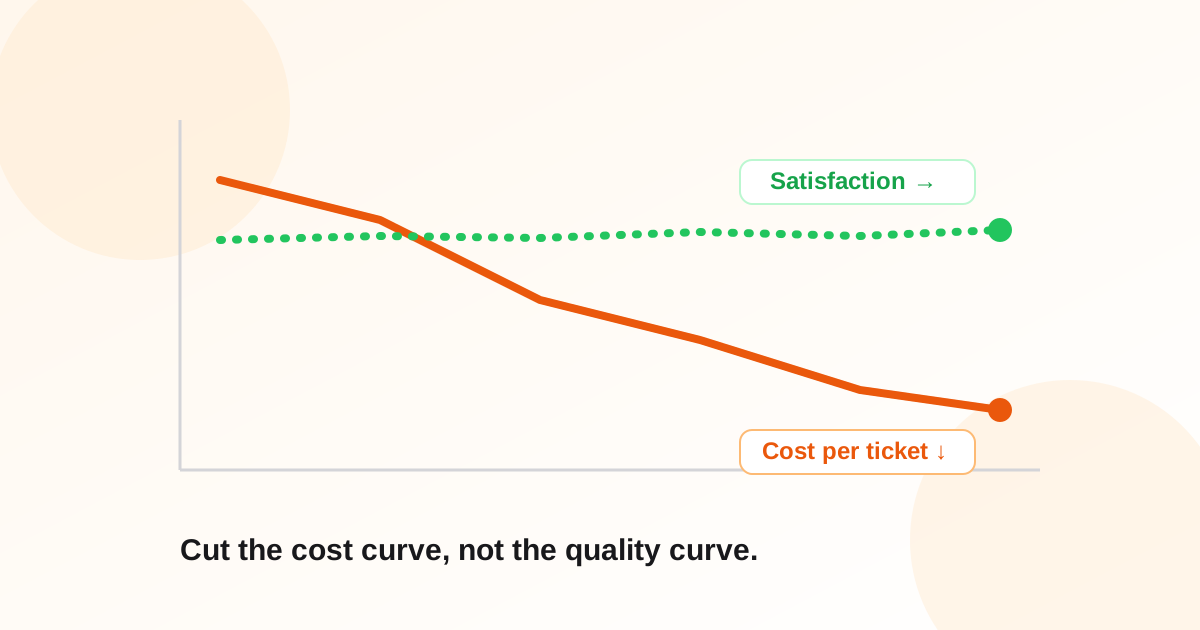
Support costs scale with ticket volume, and ticket volume scales with growth — which is how successful companies end up with their support budget growing faster than revenue. The fix isn't answering tickets faster. It's making the repetitive ones never arrive.
This playbook is ordered by effort-to-impact. Do it top to bottom; most teams see meaningful movement within a month.
1. Find your repeat offenders (one afternoon)
Export your last 200–500 tickets and tag them by question, not by product area. Every team that does this finds the same shape: 10–20 questions generate 40–70% of volume. Those are your targets — everything else in this playbook aims at that list.
2. Answer them before they're asked (one week)
For each repeat offender, put the answer where the question happens — not buried in a help center nobody visits.
- Shipping questions → answer on the product and checkout pages, not a policy page
- Setup questions → a checklist in the post-purchase email
- Billing questions → plain-language notes directly on the invoice
- 'Where is my order?' → proactive status emails at every stage
3. Let AI handle the front line (one afternoon to pilot)
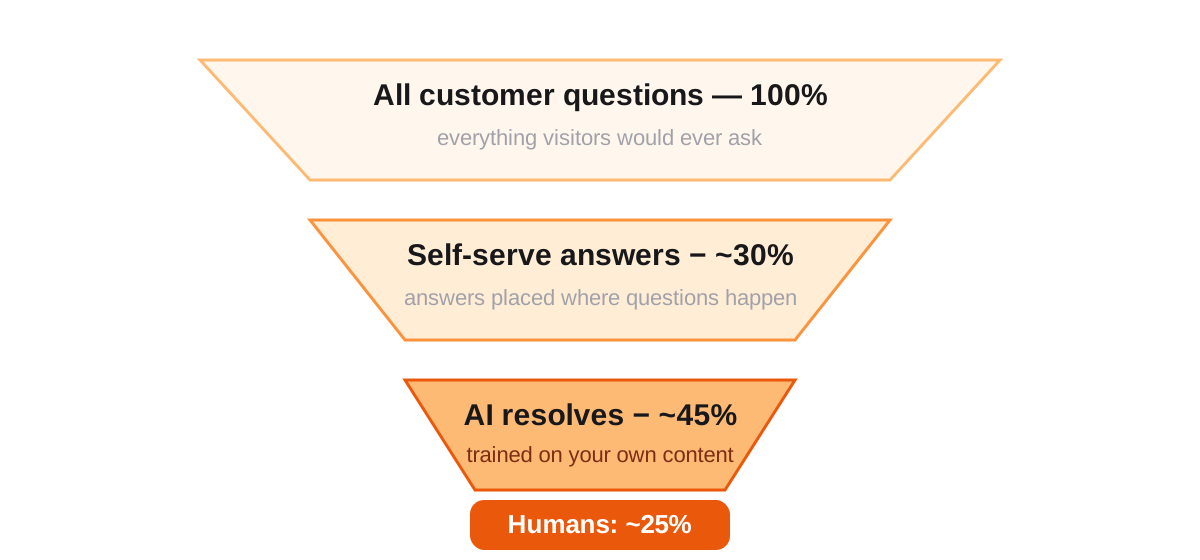
A chatbot trained on your actual content — your pages, docs, and those repeat-offender answers — typically resolves 40–75% of conversations without a human. The economics are blunt: an agent-handled ticket costs $3–8 in wages; an AI-handled one costs cents.
The rule that keeps quality intact: AI answers what it knows, and hands off what it doesn't — visibly and fast. A bot that bluffs is more expensive than no bot, because every wrong answer becomes an angrier ticket.
4. Make human replies cheaper without making them worse
For the tickets that still reach people, the cost lever is drafting time, not typing speed.
- AI-drafted replies an agent edits beat both raw templates (robotic) and from-scratch writing (slow) — teams report 2–4× throughput
- Macros for process, not prose: canned steps with a personalized opening line
- One-touch resolution as the target metric: every reply that fully closes the loop kills the follow-up ticket
5. Measure what actually proves savings
Cost per resolution is the only number that settles arguments. Track it alongside deflection rate (tickets resolved without a human), first-response time, and CSAT — if CSAT holds while cost per resolution falls, the cuts are real; if CSAT drops, you've cut quality and the churn bill arrives later.
The honest math
A team handling 2,000 conversations a month at 6 minutes each is paying for 200 agent-hours. At 55% AI deflection, 110 of those hours disappear — roughly $2,000/month at typical support wages, against tooling that costs a fraction of that. Run your own numbers rather than trusting ours:
Put your own volume and wages into the calculator.
Free Chatbot ROI CalculatorFrequently asked questions
How much can AI actually cut support costs?
Teams typically see 30–60% lower cost per resolution within a quarter, driven mostly by deflection (40–75% of conversations resolved without an agent). Your mileage depends on how repetitive your ticket mix is — audit it first.
Will cutting support costs hurt customer satisfaction?
Not if you watch CSAT alongside cost per resolution. Deflection done right answers people faster than a queue ever did; it only hurts satisfaction when the bot bluffs instead of handing off to a human.
What's the cheapest first step?
The ticket audit — one afternoon, zero spend. Tagging your last few hundred tickets by question tells you exactly which 10–20 answers would remove the most volume.
Should I reduce headcount after automating?
Most teams don't — they redirect people from repetitive tickets to revenue-adjacent work: onboarding, proactive outreach, and the complex cases that build loyalty. Growth usually absorbs the capacity.